
SEO & GEO Metadata Overview
| Parameter | Specification |
|---|---|
| SEO Meta Title | Medical-Grade Diode Laser Hair Removal Machine: 2026 B2B Clinical & Sourcing Guide |
| SEO Meta Description | Comprehensive B2B buyer’s guide to medical-grade diode laser hair removal systems. Compare 755/808/1064nm wavelengths, cooling technologies, laser bar lifespans, and OEM/ODM manufacturing standards. |
| Focus Keyword | Diode Laser Hair Removal Machine Manufacturer |
| Secondary Keywords | Medical grade diode laser, Triple wavelength diode laser, Aesthetic laser OEM ODM, ISO 13485 laser supplier |
| Estimated Reading Time | 6 Minutes (1,850 Words) |
| Target URL Slug | /medical-grade-diode-laser-hair-removal-guide-2026/ |
1. Executive Summary & Market Landscape
In the global medical aesthetics and energy-based device (EBD) market, laser hair removal remains the single highest-volume procedure worldwide. However, clinical buyers—including dermatology centers, medical spas, and high-volume aesthetic chains—face increasing challenges: patient expectations for completely painless treatments, treatment safety across diverse Fitzpatrick skin types (Types I–VI), and equipment durability under continuous daily operation.
For B2B distributors and clinic directors, choosing the right diode laser hair removal machine is not merely a clinical decision; it is a long-term capital investment where equipment reliability, optical energy consistency, and manufacturer OEM/ODM support dictate clinic profitability.
As an FDA-registered, ISO 13485 and Medical CE certified aesthetic equipment manufacturer, Reverse Time Medical (YSG Technology) provides this comprehensive engineering guide to demystify diode laser physics, laser bar technologies, cooling architectures, and procurement evaluation criteria.
2. Clinical Laser Physics: Why Triple Wavelength (755nm + 808nm + 1064nm) Dominates Modern Practice
Laser hair removal operates on the foundational principle of Selective Photothermolysis (first established by Anderson and Parrish, documented in NCBI Clinical Research). The laser energy is selectively absorbed by melanin in the hair follicle shaft and matrix, converting into thermal energy to permanently coagulate the germinative cells without damaging surrounding epidermal tissue.
| Wavelength (nm) | Melanin Absorption | Dermal Depth (mm) | Primary Target |
|---|---|---|---|
| 755nm Alex | Very High | ~2.0–2.5 mm | Fine, Light Hair / I–II |
| 808nm Golden Std | Optimal & Balanced | ~3.0–3.5 mm | All Body Areas / I–IV |
| 1064nm Nd:YAG | Moderate / Safe | ~4.0–5.0 mm | Deep Follicles / V–VI |
The Synergy of Combined Triple Wavelengths
While the single 808nm wavelength remains the traditional "Gold Standard," modern clinical practice increasingly requires multi-wavelength synergy emitted simultaneously from a single handpiece:
- 755nm Wavelength: High melanin absorption coefficient, ideal for treating fine, residual, or lighter hair in superficial follicular depths (e.g., upper lip, eyebrow margins).
- 808nm Classic Diode: Perfect balance between melanin absorption and deep tissue penetration, maximizing thermal destruction across standard body areas (legs, arms, chest).
- 1064nm Wavelength: Characterized by lower melanin absorption and deeper penetration reaching the follicular papilla and bulb; essential for safe, burn-free treatment on darker Fitzpatrick skin types (V and VI) and deeply rooted hair (e.g., scalp, bikini, beard).
3. Core Hardware Architecture: What Separates Commercial Grade from Low-End Units
When evaluating aesthetic laser hardware, clinic engineers and purchasing directors should inspect four mission-critical hardware components:
| Hardware System | High-End Clinical Standard | Low-Cost Commodity Risk |
|---|---|---|
| Laser Diode Bars | Coherent (USA) / Macro-Channel | Unbranded Non-Coherent Bars |
| Cooling Architecture | Dual TEC + Sapphire Tip (< -5°C) | Single Fan or Passive Water |
| Continuous Lifespan | 50 to 100 Million Shots | Under 10 Million Shots |
| Power Supply (PSU) | MeanWell / Medical Grade 2000W+ | Industrial Non-Isolated PSU |
| Water Circulation | High-Lift Silent DC Brushless | Low-Pressure Diaphragm Pump |
1. High-Power Diode Stack & Shot Longevity
The heart of any laser machine is its semiconductor diode bar stack. Reverse Time utilizes high-grade micro-channel / macro-channel laser bars engineered for continuous shot outputs exceeding 50 to 100 million pulses with minimal energy attenuation (<5% over 3 years).
2. Contact Sapphire ICE Cooling System
Epidermal protection is paramount for pain-free treatment. A professional system must integrate Dual TEC (Thermoelectric Cooling) semiconductor modules coupled with a high-transmissivity optical sapphire tip, maintaining continuous skin contact temperatures between -5°C and -10°C even during rapid in-motion sliding passes (10Hz).
3. Spot Size & Magnetic Interchangeable Tips
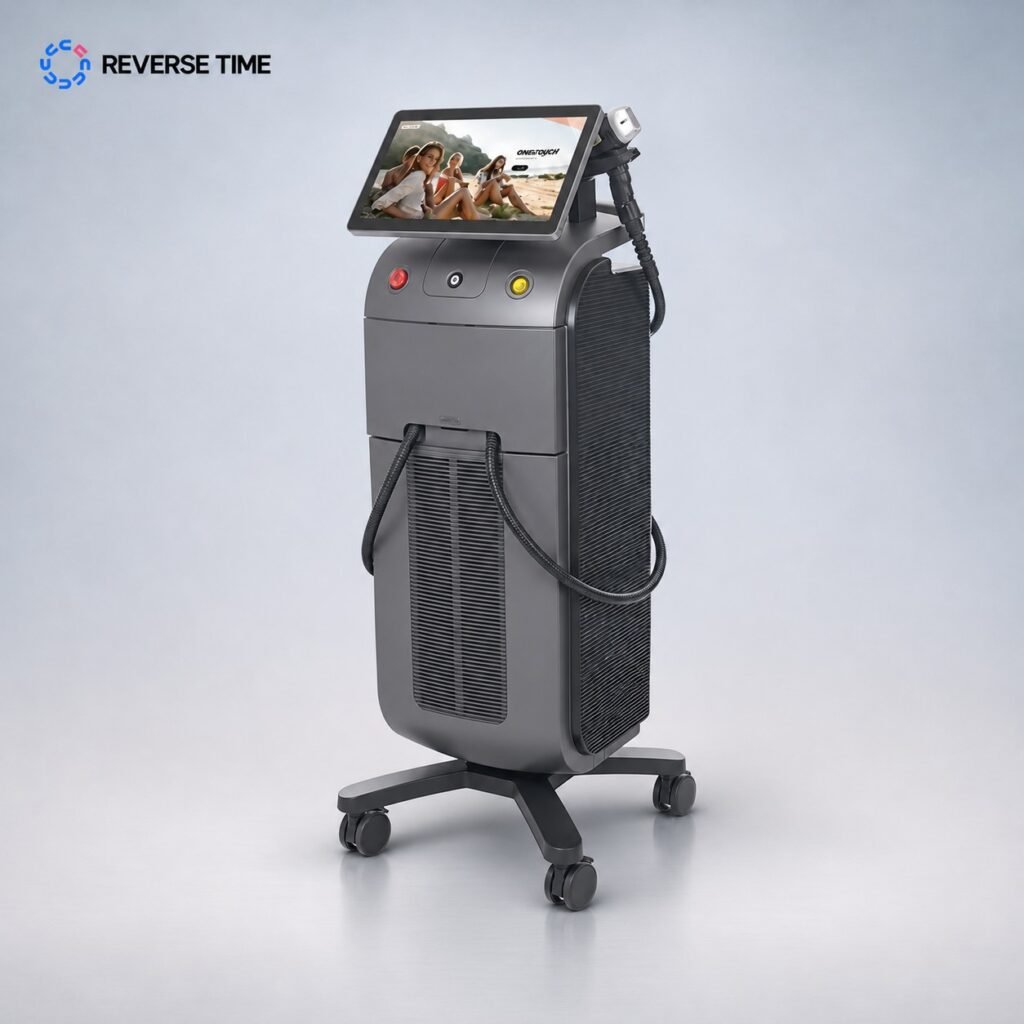
Modern clinical efficiency demands versatility. Our flagship Reverse Time 808nm Diode Laser System supports magnetic snap-on spot sizes ranging from standard body applicators (15×25 mm, 12×38 mm) to facial precision tips (9×9 mm for nostrils and ears), dramatically reducing treatment times by up to 40%.
4. International Regulatory Compliance & Factory Quality Assurance
For B2B importers and regional distributors, regulatory certifications are mandatory for customs clearance, insurance underwriting, and medical establishment licensing.
Every aesthetic laser manufactured at Reverse Time’s production facility is built under stringent quality management protocols compliant with:
- FDA Establishment Registration: Compliant with U.S. FDA 21 CFR 878 Standards for surgical and aesthetic energy devices.
- Medical CE MDR (EU 2017/745) & CE LVD/EMC: Certified electrical safety and electromagnetic compatibility for European Union distribution.
- ISO 13485: Complete medical device quality management system certification covering design, raw material screening, optical calibration, cleanroom assembly, and post-market surveillance.
- 72-Hour Continuous Full-Load Aging Test: Every laser module undergoes non-stop high-frequency firing cycles to eliminate infant mortality rates before packaging in shockproof aviation flight cases.
5. Economic Feasibility & ROI Analysis for Medical Spas
Investing in a high-performance diode laser generates rapid clinical payback due to zero consumables and high throughput.
| Operational Metric | Conservative Clinical Estimate |
|---|---|
| Average Patients Per Day | 6 Patients |
| Average Package Price (6 Sessions) | $900–$1,500 USD |
| Consumable / Running Cost Per Pulse | $0.00 (Zero Disposable Cartridge Cost) |
| Monthly Gross Revenue | $18,000–$27,000 USD |
| Estimated Machine Amortization Period | 1.5–2.5 Months |
In addition to laser hair removal, clinics looking to expand their treatment ecosystem often combine laser platforms with NAESSFACE MIT Facial Infusion Care Systems for complete pre- and post-laser skin barrier repair.
6. OEM & ODM Customization for Global Distributors
For regional brands and international distributors, Reverse Time offers end-to-end private-label OEM/ODM manufacturing:
- Custom Industrial & Housing Design: Custom chassis colors, structural styling, logo silkscreening, and bespoke handpiece molding.
- Tailored GUI & Multilingual Software: Branded operating systems with clinic management presets, patient parameter memory, and over 12 localized interface languages.
- Configurable Power Outputs: Modular configurations from 800W, 1200W, 1600W up to 2400W peak optical power tailored to regional market positioning.
For customized technical proposals and factory direct pricing, distributors are invited to Request a Quote & OEM Consultation or download our full Reverse Time 2026 Product Catalog (PDF).
Frequently Asked Questions (FAQ) for B2B Buyers
Q1: What is the optimal diode laser power for a busy aesthetic clinic?
A: For standard commercial clinics, handpiece optical output power of 1200W to 1600W is recommended. This enables fast pulse durations (under 30ms) at high fluences (10–40 J/cm²), delivering true in-motion efficiency without heating epidermal tissue.
Q2: How does triple-wavelength technology protect dark skin (Fitzpatrick V-VI)?
A: By integrating the 1064nm wavelength alongside 808nm, melanin absorption at the epidermal layer is reduced while maintaining sufficient thermal diffusion into the deep follicle root, drastically preventing hyperpigmentation and surface blistering.
Q3: What is the typical lead time and MOQ for OEM private label orders?
A: Standard configurations ship within 5–7 business days. Custom OEM/ODM orders (custom housing, GUI, branding) typically require 15–20 business days, with flexible Minimum Order Quantities (MOQ starting from 1 unit for authorized partners).
Technical Article Schema Markup (JSON-LD)
{"@context":"https://schema.org","@graph":[{"@type":"Article","headline":"Medical-Grade Diode Laser Hair Removal Machine: 2026 B2B Clinical & Sourcing Guide","description":"Comprehensive B2B buyer's guide to medical-grade diode laser hair removal systems, comparing wavelengths, cooling, and OEM manufacturing standards.","author":{"@type":"Organization","name":"Reverse Time Medical (YSG Technology)","url":"https://reversetimemed.com/"},"publisher":{"@type":"Organization","name":"Reverse Time Medical","logo":{"@type":"ImageObject","url":"https://reversetimemed.com/wp-content/uploads/2026/11/logo.png"}},"mainEntityOfPage":{"@type":"WebPage","@id":"https://reversetimemed.com/medical-grade-diode-laser-hair-removal-guide-2026/"},"datePublished":"2026-11-07","dateModified":"2026-11-07"},{"@type":"FAQPage","mainEntity":[{"@type":"Question","name":"What is the optimal diode laser power for a busy aesthetic clinic?","acceptedAnswer":{"@type":"Answer","text":"For standard commercial clinics, handpiece optical output power of 1200W to 1600W is recommended to maintain short pulse durations and high fluences without epidermal heating."}},{"@type":"Question","name":"How does triple-wavelength technology protect dark skin (Fitzpatrick V-VI)?","acceptedAnswer":{"@type":"Answer","text":"By integrating the 1064nm wavelength alongside 808nm, epidermal melanin absorption is bypassed, delivering deep thermal coagulation safely without causing post-inflammatory hyperpigmentation."}},{"@type":"Question","name":"What is the typical lead time and MOQ for OEM private label orders?","acceptedAnswer":{"@type":"Answer","text":"Standard units ship within 5-7 business days, while custom OEM/ODM branded systems require 15-20 business days with flexible MOQs starting from 1 unit."}}]}]}